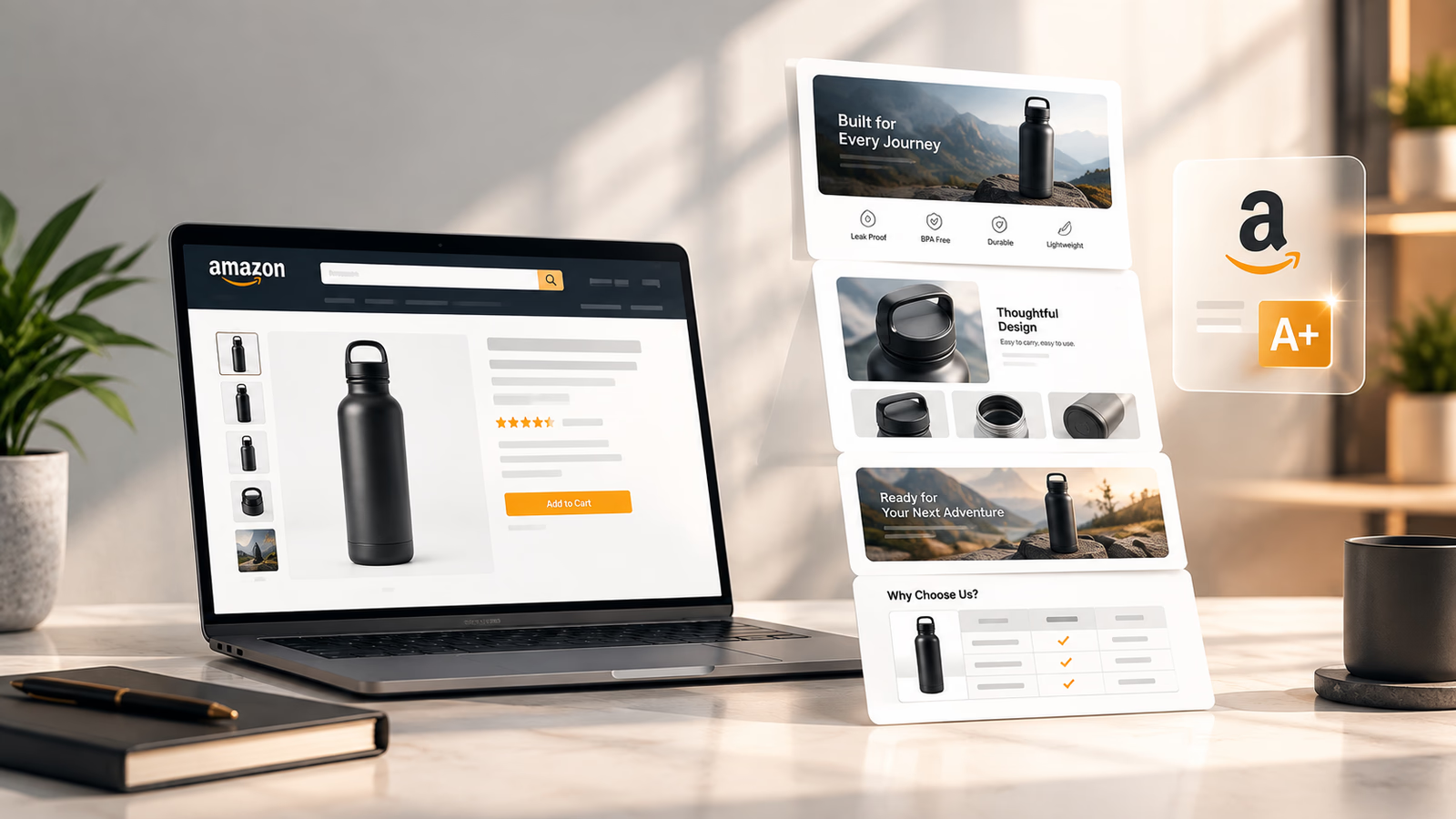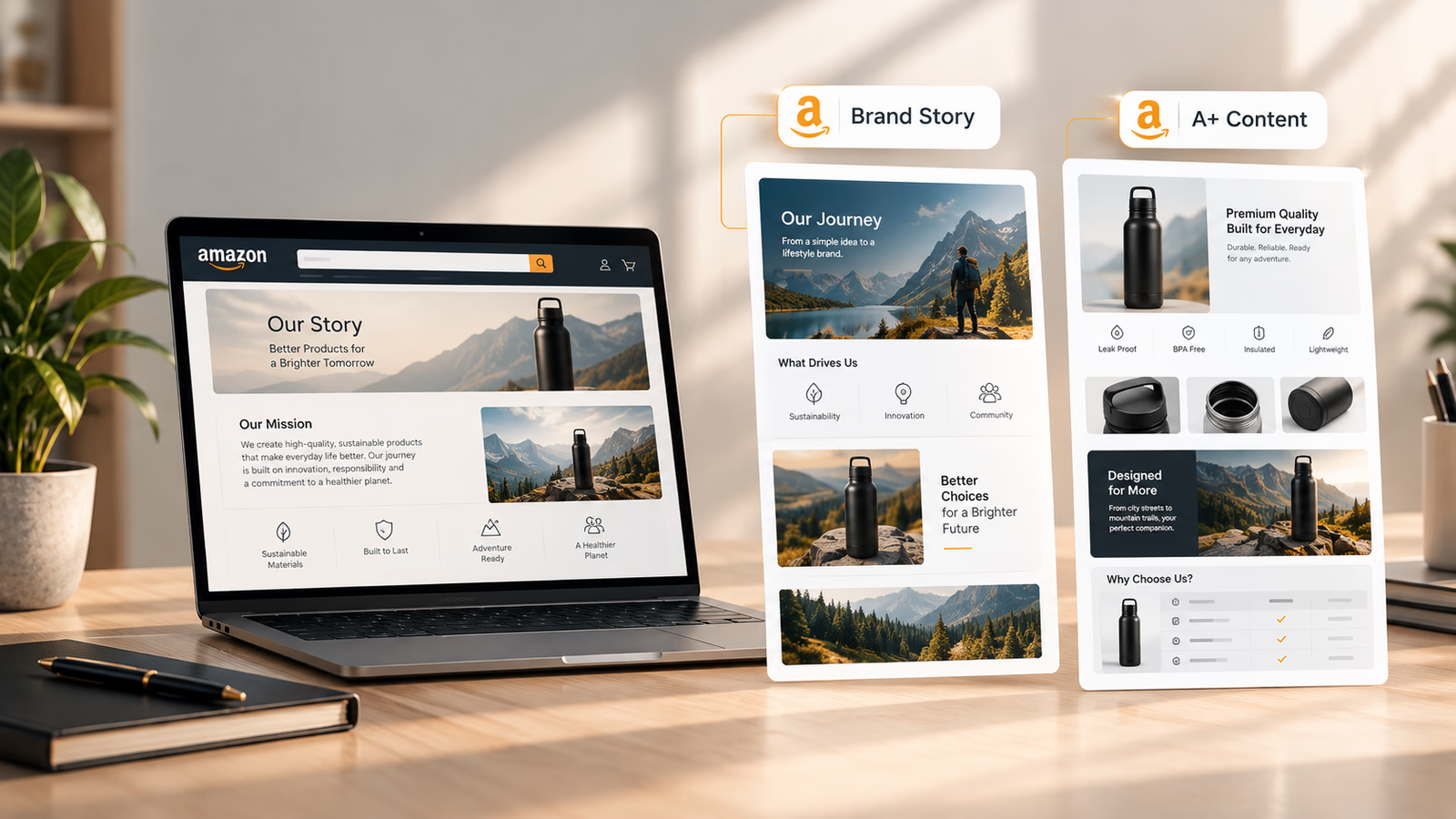

Amazon gives registered brands several ways to add richer content to product detail pages. Two of the most important are A+ Content and A+ Brand Story.
They are easy to confuse because both use images, text, and branded design.
Their jobs are different.
A+ Content is mainly about the product. It gives you more room to explain benefits, features, technical details, comparisons, and common purchase questions.
Brand Story is about the brand and the catalog around the product. It gives shoppers a place to understand the brand, discover related products, and move toward the Amazon Brand Store.
Amazon's current documentation places A+ Content in the Product Description section and Brand Story in the From the brand section. Amazon describes Brand Story as a way to share the brand's story, values, and mission across product listings, while also giving shoppers links to the Brand Store and other products in the catalog.
That leads to an important question: should a brand prioritize A+ Content or Brand Story?
For most listings, the answer depends on what is currently missing.
If the product page still has unanswered product questions, A+ Content usually deserves attention first.
If the product content is already strong and the brand has multiple related ASINs, Brand Story becomes more valuable.
And for brands working toward Premium A+ eligibility, Brand Story has an additional practical role because Amazon currently includes published Brand Story across all owned ASINs in its eligibility criteria. Understanding amazon brand story guidelines ensures your catalog creative achieves both goals without wasting production resources.
What Is A+ Brand Story on Amazon?
A+ Brand Story is a brand-focused content experience that appears under From the brand on eligible product listings.
Amazon's current A+ materials describe Brand Story as a content type for sharing the brand's story, values, and mission across product listings. It can also direct shoppers toward the brand's Store and other products in the catalog. The current Amazon quick guide lists up to 19 modules, with a 362 x 453 px image size for Brand Story imagery (Amazon Media).
You do not have to use all 19 modules.
In most cases, a shorter story with a clear purpose is easier to follow than a long sequence of repetitive cards.
A useful Brand Story can cover:
- Why the brand exists
- What the brand believes
- How products are designed
- What connects the product line
- Which other products shoppers may need
- Where to explore the wider catalog
The emphasis should stay on the brand.
A detailed explanation of one ASIN's battery, dimensions, or compatibility generally belongs in that ASIN's A+ Content.
Brand Story vs. A+ Content
The simplest distinction is: A+ Content explains the product, while Brand Story explains the brand behind the product.
That sounds simple, but it changes how you design each section.
Amazon explicitly distinguishes Brand Story from Basic and Premium A+ and states that Brand Story is used under From the brand, while enhanced product description content is used under Product description.
Sellers who managed Amazon accounts prior to the interface update often search for ebc vs brand story. Enhanced Brand Content (EBC) was Amazon's legacy name for what is now Basic A+ Content in Seller Central. In practical terms, EBC was not replaced by Brand Story; rather, EBC evolved into standard product-level A+ Content, while Brand Story was launched as a separate, horizontal carousel directly above it in the From the brand slot.
So this is not a case where one replaces the other. A well-built listing can use both.
Where Brand Story Fits on an Amazon Listing
Amazon identifies the Brand Story section as From the brand. Basic and Premium A+ Content are placed under Product description.
This matters because the two areas have different information jobs.
A shopper reading the product description area is usually evaluating the product. A shopper seeing the brand section has an opportunity to learn who is behind the product and what else that brand offers.
The exact visual position on a live detail page can vary with Amazon's layout, so it is safer to describe these by their Amazon section names rather than promising a fixed screen position for every listing.
What Should an Amazon Brand Story Actually Say?
A Brand Story should not read like the company's About Us page copied into Amazon. It needs to work in the context of a shopper who is already looking at a product.
Start with the most relevant part of the story.
1. Why Does the Brand Exist?
Give the shopper a reason to care.
For example:
- We started with a simple problem: everyday storage products were either too bulky or too difficult to organize.
That is far more useful than:
- Our company was founded in 2018 with the mission to provide high-quality products.
The second sentence could describe thousands of brands. The first gives the shopper a reason to continue.
2. What Does the Brand Believe?
This could be:
- Simpler home organization
- Better materials
- More durable tools
- Practical outdoor equipment
- Better everyday design
Keep the statement specific enough to mean something.
3. How Does That Belief Affect the Products?
This is where brand story becomes more credible.
If the company claims to focus on durability, show the material, construction approach, or design decision that reflects it. The story should connect to something the shopper can actually see.
Amazon Brand Story Examples: Think in Cards, Not Paragraphs
The carousel format works best when each card has one clear job.
Example 1: Outdoor Brand
- Card 1: Built for better days outside
- Card 2: Why the brand started
- Card 3: Product design philosophy
- Card 4: Material and durability approach
- Card 5: Related outdoor products
- Card 6: Explore the full Brand Store
Example 2: Home Organization Brand
- Card 1: Make better use of everyday spaces
- Card 2: The problem that inspired the brand
- Card 3: Design principles
- Card 4: How the products work together
- Card 5: Explore storage solutions
- Card 6: Shop the complete collection
The examples above are illustrative structures, not Amazon-required templates.
Amazon's own Brand Story guide shows examples of using the format for brand values, expanded Store offerings, new product launches, and seasonal events (Amazon Media).
The Amazon Brand Story Carousel
Brand Story uses a carousel-style experience.
Amazon's current documentation and quick guide list 19 maximum modules for Brand Story. Amazon's older Brand Story quick-start guide also documented a minimum of one and maximum of 19 modules.
That number is a ceiling, not a recommendation to use all 19.
A useful way to plan the carousel is a sequential five-stage progression: introduce, explain, prove, connect, and discover.
For example:
- Brand introduction
- Origin or purpose
- Product philosophy
- What makes the approach different
- Product family
- Brand Store
Six well-structured cards may tell the story more effectively than nineteen cards that repeat variations of the same message.
Amazon Brand Story Size: What Should You Use?
This is one area where older tutorials can create problems.
You may still find older references to 1464 x 625 px desktop backgrounds and 463 x 625 px mobile crops. Do not treat those old numbers as the current universal Brand Story specification.
Amazon's current A+ quick guide lists 362 x 453 px for Brand Story imagery (Amazon Media).
Because Amazon updates templates and content specifications, the safest production workflow is: use the dimensions shown by the current A+ Content Manager for the exact Brand Story module you are creating.
For a production team, that means the design file should be built around the current module rather than an old blog post or saved specification sheet. It also means checking the final preview on the actual Amazon desktop and mobile layouts before submitting.
Do Not Design Brand Story Around One ASIN
This is one of the most important differences between Brand Story and A+ Content.
A+ Content is generally built to answer questions about a specific product. Brand Story can be applied across a brand's product catalog.
Amazon's Premium A+ eligibility documentation says that the brand must have published A+ Brand Story to all ASINs the brand owns within its catalog. Amazon's A+ Content Manager is used to apply Brand Story to ASINs and submit it for review.
That means the story needs to survive across the product line.
For example:
- We design tools for smaller workshops. (could remain relevant across several tool categories)
But:
- Our 18-inch drill uses a 2.0 Ah battery. (belongs strictly to the drill's product content)
Brand Story should build catalog-level meaning, not become another specification sheet.
When Should You Prioritize A+ Content?
Start with A+ when the shopper still has important product questions.
Typical examples include:
- What exactly does this product do?
- What makes it different?
- How is it used?
- What are the important specifications?
- Will it fit?
- Is it compatible?
- What comes in the box?
- Which version should I choose?
Amazon describes enhanced product-description content as a way to highlight key features, provide product information, and help shoppers make more informed purchase decisions.
For a single-product brand, this distinction is especially important. There may be little value in spending most of the content budget on a lengthy brand story while the product itself is still poorly explained. Fix product clarity first.
When Should You Prioritize Brand Story?
Brand Story becomes more useful when the brand has something larger to communicate than one ASIN.
That is particularly true when:
- You have multiple related products: A shopper buying one product may reasonably need another.
- Your products form a system: For kitchen brands, think coffee maker, grinder, filters, and bean storage. For office accessories, think desk, monitor stand, cable organizer, and desk lamp. Brand Story can introduce the relationship between those products.
- The brand has a real point of view: A specific product philosophy is more useful than generic statements about quality and innovation.
- Your A+ Content is already strong: Once the product-level questions are covered, Brand Story can provide the wider brand context.
- You are working toward Premium A+: Amazon currently includes published Brand Story across owned ASINs and at least five approved and published A+ projects in the previous 12 months among its Premium A+ eligibility criteria. Amazon says eligibility is re-evaluated weekly.
A Practical Priority by Brand Situation
This is not an Amazon ranking formula. It is a content-planning decision.
Brand Story Is a Catalog Tool, Not Just a Brand Biography
A strong Brand Story should create a connection between the product the shopper is viewing and the rest of your business.
Imagine a candle brand. The shopper lands on one scent. The Brand Story can communicate:
- Why the brand makes candles
- What the brand values
- How the collection is organized
- What other scents or products exist
- Where to explore the full range
Amazon says Brand Story can include links to a brand's Store and other products in its catalog, specifically giving it a role in brand discovery and cross-selling.
That makes the Brand Story more useful than a generic company history. It should give the shopper somewhere meaningful to go next.
Cross-Selling Without Turning the Story Into an Advertisement
Cross-selling works best when the connection is natural.
- A shopper viewing a coffee grinder may reasonably be interested in a coffee maker.
- A shopper viewing a monitor stand may be interested in a desk lamp.
- A shopper viewing one skincare product may be interested in the rest of the routine.
The mistake is showing unrelated products simply because the brand sells them. The catalog connection should make sense.
A useful question is: what would this shopper plausibly need next? That gives the Brand Story a more useful cross-selling role.
Brand Story and A+ Should Share the Same Visual System
The layouts should not be identical, but the brand should still feel consistent.
Carry the same core elements across:
- Typography
- Brand colors
- Product-rendering style
- Photography treatment
- Iconography
- Spacing
- Tone of voice
For example:
- Brand Story narrative structure: Brand promise, origin, philosophy, product family, and Brand Store navigation.
- A+ Content narrative structure: Product introduction, benefits, features, visual proof, technical details, and objection removal.
The visual system connects the two. The information architecture keeps their jobs separate.
For a broader look at product-level A+ structure, explore our A+ Content design guide.
3D Rendering Can Help Build Brand Consistency
3D becomes particularly useful when a brand sells visually complex products or several related variants.
One accurate product model can support:
- Listing images
- A+ Content
- Brand Story
- Brand Store assets
- Advertising creatives
For example, a furniture brand could use the same product model across room scenes, material close-ups, different color variants, and product-family compositions. That creates consistency without forcing every image to use the same composition.
The important word is accurate. A beautiful render with incorrect dimensions, materials, or components is still misleading.
A Real Example of Why the Visual System Matters
Grow Orbit's published Kazvo Home & Auto case study shows how a product can be rebuilt as a connected visual system rather than a series of unrelated graphics. The project combined listing images, A+ Content, main-image work, high-tech infographics, and feature callouts around the product's 22,000 Pa suction and 4-in-1 functionality (Kazvo Case Study).
The case study is not an isolated Brand Story experiment, so its reported growth figures should not be interpreted as proof that Brand Story itself caused the result.
The useful lesson for Brand Story work is the visual-system approach. A product should not look completely different between the listing gallery, A+ modules, and broader brand content.
The same product asset library, typography, and visual rules can make those surfaces feel connected.
Want to connect your Amazon listings into a high-converting catalog system? Book a zero-pressure review with our creative team to audit your Brand Story architecture.
📅 BOOK A FREE 1-ON-1 BRAND STORY AUDITA Brand Story Structure for a Multi-ASIN Brand
If you need a starting framework, use this:
- Card 1: The brand promise. One clear statement.
- Card 2: The reason the brand exists. Tell the origin story briefly.
- Card 3: The product philosophy. Explain how that belief influences what you make.
- Card 4: Evidence. Show materials, craftsmanship, process, or product detail that supports the story.
- Card 5: The collection. Connect the shopper to related products.
- Card 6: Continue exploring. Send them toward the relevant Brand Store or catalog.
You can expand from there if the brand genuinely has more to say. You do not need to fill every available card.
What Makes a Brand Story Feel Generic?
Some phrases appear on thousands of ecommerce sites:
- We believe in quality.
- Innovation is at the heart of everything we do.
- Designed with customers in mind.
The problem is not that these statements are false. The problem is that they tell the shopper almost nothing.
A stronger statement contains a concrete idea.
Instead of:
- We believe in quality.
Try:
- We design kitchen tools around one requirement: they need to survive the part of cooking that happens every day, not just the photoshoot.
That gives the shopper something specific to associate with the brand. A Brand Story becomes stronger when it sounds like this brand, not any brand.
Brand Story Should Be Honest About the Product
The brand story should never create expectations that the product cannot support.
Check:
- Materials
- Manufacturing statements
- Certifications
- Sustainability claims
- Country-of-origin claims
- Performance language
- Warranty statements
- Product compatibility
If you say the brand focuses on a particular material, the products shown should support that story. If you claim a special manufacturing process, make sure it is real. Strong storytelling does not require exaggeration.
A Simple Brand Story Audit
Open your current Brand Story and ask:
- Does the first card explain why I should care? If it could belong to any company, rewrite it.
- Does every card add something? Remove repetitive cards.
- Is the story relevant to the product? A company history that has nothing to do with the product does not help much at the point of purchase.
- Does the catalog connection make sense? Only promote products that are genuinely related.
- Can I see evidence of the brand's claims? Show the materials, products, process, or design decisions whenever possible.
- Is there a useful next step? The shopper should know where to go after the story.
Brand Story Publishing Checklist
Before submitting, review the project at three levels.
Brand Level
- Is the story specific to the brand?
- Does it explain a real point of view?
- Does it remain relevant across owned products?
Product Level
- Are the products shown accurately?
- Are the links correct?
- Are product claims supported?
- Is detailed product education left to A+ where appropriate?
Technical Level
- Are the current module dimensions being used?
- Does the content look good on the current Amazon layout?
- Is the carousel easy to scan?
- Are the images sharp?
- Is the text readable?
- Have you checked Amazon's current content requirements before submission?
Amazon's current A+ documentation and quick guide should be treated as the source of truth for current module availability and image requirements rather than older third-party tutorials.
Frequently Asked Questions
What are the Amazon Brand Story guidelines?
Amazon Brand Story appears under From the brand and can use up to 19 Brand Story modules or cards. Amazon's current materials describe it as a way to share brand story, values, and mission while linking shoppers to the Brand Store and other products.
What is the difference between Brand Story and A+ Content?
A+ Content is primarily product-focused and appears under Product Description. Brand Story is brand-focused and appears under From the brand. A+ explains the product, while Brand Story provides broader brand context and catalog discovery.
What size should an Amazon Brand Story image be?
Amazon's current A+ quick guide lists 362 x 453 px for Brand Story imagery. Because Amazon can update module specifications, confirm the dimensions shown in the current A+ Content Manager before production.
Is Brand Story the same as EBC?
No. When comparing ebc vs brand story, remember that EBC (Enhanced Brand Content) is the older Amazon terminology for product-level A+ Content. Brand Story is an entirely separate brand-focused carousel module located in the From the brand section.
Can Brand Story and A+ Content be used together?
Yes. Amazon's current A+ materials treat Brand Story as a separate brand content type that can be used alongside Basic or Premium A+ product content.
Does Brand Story help with cross-selling?
It can. Amazon specifically says Brand Story can offer links to the brand's Store and other products in the catalog, making brand discovery and related-product exploration part of the experience.
Does Brand Story help unlock Premium A+?
Amazon's current Premium A+ eligibility criteria include having a published Brand Story on all ASINs the brand owns in its catalog, plus at least five approved and published A+ Content projects within the previous 12 months. Amazon says eligibility is re-evaluated weekly.
How many Brand Story cards should I use?
Amazon allows up to 19 modules, but there is no requirement to use all 19. Use enough cards to communicate the brand clearly, provide relevant catalog context, and give the shopper a useful next step.
Final Takeaway on Amazon Brand Story Guidelines
Brand Story and A+ Content are not two versions of the same thing. They have different jobs.
A+ Content explains the product. Brand Story explains the brand around the product and helps shoppers discover the wider catalog.
For a new listing with weak product education, build the product-level content first.
For a mature catalog with several related products, Brand Story can add the missing layer of brand context and cross-product discovery.
For brands working toward Premium A+ eligibility, Brand Story also has a practical role because Amazon currently includes published Brand Story across owned ASINs in its eligibility requirements.
Do not fill the carousel with generic company history. Do not turn Brand Story into another specification sheet.
Give it a clear purpose:
- Why does this brand exist?
- What does it stand for?
- What connects its products?
- Where should the shopper go next?
When you align your creative with established amazon brand story guidelines, partnering with dedicated specialists in Amazon Brand Story design transforms the section from a decorative banner into an engine for catalog-wide marketplace growth.