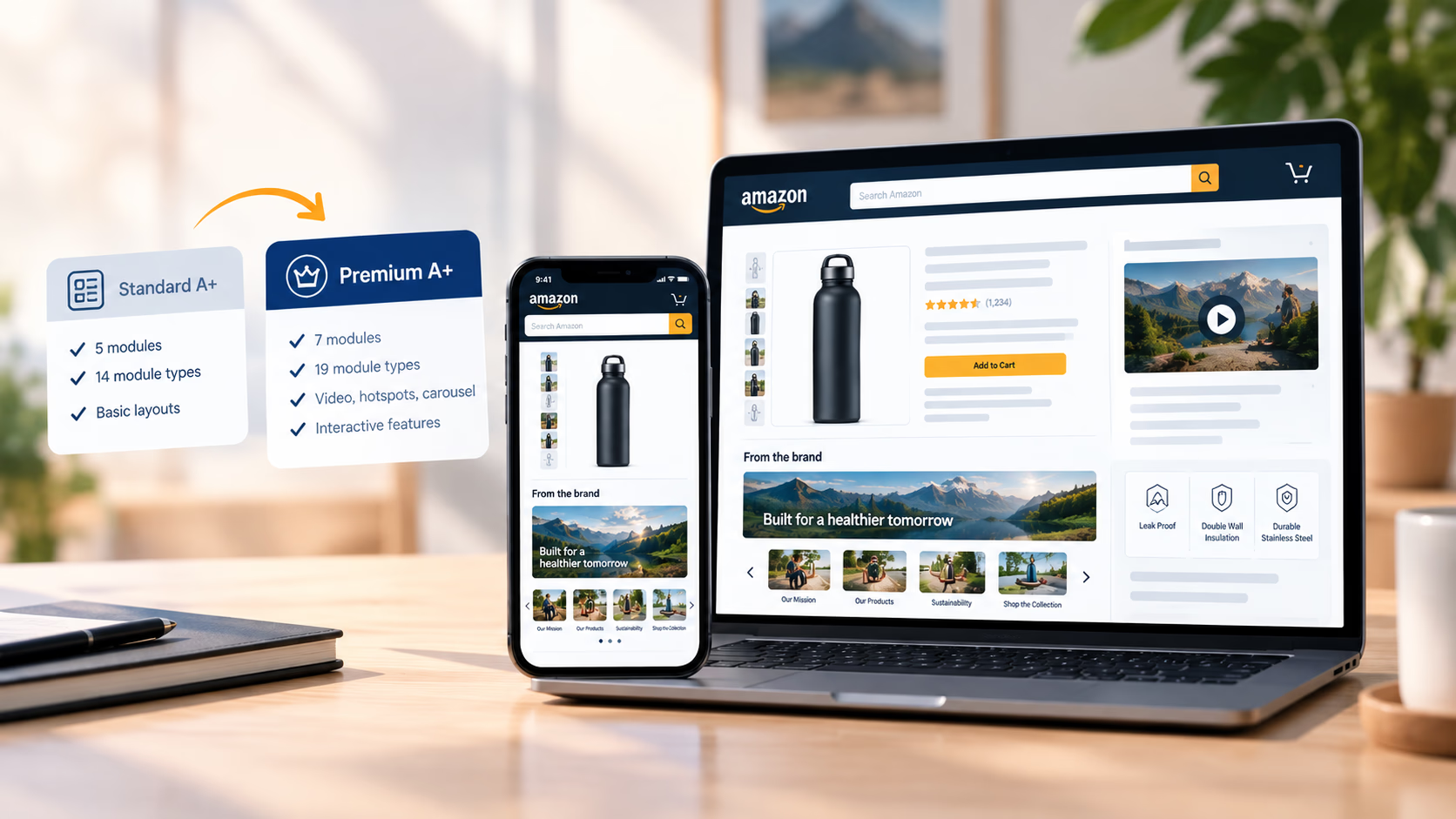

Premium A+ Content gives Amazon brands more ways to explain their products through larger visual layouts, video, interactive hotspots, and additional content modules. These features can be useful for products that need detailed demonstrations or comparisons, but they also require time and money to produce well.
For some listings, five clear A+ modules are enough. Others could benefit from more interactive content, especially when customers need to understand technical features, compare product variations, or see how something works before buying.
The financial decision comes down to a practical question: can the additional content generate enough contribution profit to justify its production cost?
This guide compares Basic and Premium A+, breaks down the return-on-investment calculation, and explains when the upgrade deserves priority.
What Is Amazon Premium A+ Content?
Amazon Premium A+ Content is an expanded version of A+ product-detail content available to eligible brands. It includes the features offered by Basic A+ alongside additional options such as video, interactive hotspots, clickable image or video carousels, Q&A modules, shoppable content, and larger high-resolution formats.
These features give brands more ways to explain complicated products and help shoppers evaluate their options. Amazon's Seller Central documentation explains the available content types and Premium eligibility requirements.
Basic A+ vs. Premium A+: What's the Difference?
Amazon's current A+ Content Quick Guide lists five maximum modules and 14 module types for Basic A+, compared with seven maximum modules and 19 module types for Premium A+.
Image dimensions vary by module, so there is no single width and height that applies to every Basic or Premium A+ asset. Use the specifications shown in your current A+ Content Manager when preparing production files.
The additional features are useful when they solve a genuine product-information problem. A simple kitchen accessory may need only a few well-designed sections. A technical product with several components, operating modes, or compatibility requirements may benefit from video and interactive explanations.
For a broader look at module planning and visual hierarchy, see our Amazon A+ content design guide.
What Does Amazon Say About Premium A+ Conversion Rates?
Amazon's current A+ Content Quick Guide states that Basic A+ Content can help boost sales by up to 8%, while Premium A+ Content can help boost sales by up to 20%.
Those figures need context.
Amazon's footnote says its studies, conducted in 2022, measured products with A+ Content against products without A+ Content. The guide also says results vary with factors such as content quality, product price, and product category, and that future sales are not guaranteed.
The published figures do not establish that upgrading an existing Basic A+ page to Premium will typically increase sales by 20%. Amazon's public guide also does not provide enough methodology to calculate a typical incremental lift attributable specifically to Premium over Basic.
For budgeting purposes, use the Amazon figures as context, not as a forecast. Your own traffic, conversion rate, margin, and production costs are more useful for deciding whether a specific investment makes financial sense.
The Math Behind Amazon A+ Content ROI
The first step is to calculate how much profit you retain from an additional order.
Use contribution profit after relevant variable costs, including product cost, Amazon fees, fulfillment, discounts, and expected returns. Revenue alone can make an investment look more attractive than it actually is.
The basic formula is:
Monthly incremental contribution profit = Current monthly orders × Estimated relative order lift × Contribution profit per additional order
Then calculate the simple break-even period:
Break-even period = One-time production cost ÷ Monthly incremental contribution profit
This is a simplified model. It assumes traffic and margins stay stable and excludes additional recurring costs. Include any extra advertising spend or ongoing expenses when they apply.
A worked example
Imagine a listing with the following performance:
The following scenarios show how the payback period changes under different hypothetical outcomes.
These are illustrative calculations, not expected Premium A+ results.
The 10% scenario, for example, assumes the listing moves from 240 orders to 264 orders per month. With 3,000 sessions, that represents a conversion-rate change from 8% to 8.8%, or a 10% relative increase in orders.
The example also shows why traffic and margin matter. An ASIN that already attracts qualified visitors and earns healthy contribution profit can recover its creative investment faster than a low-volume product with thin margins.
For help addressing listing performance more broadly, explore our Amazon conversion optimization ROI services.
Want to determine whether Amazon Premium A+ Content or 3D renders will produce a positive ROI for your catalog? Book a zero-pressure review with our creative team.
📅 BOOK A FREE 1-ON-1 PREMIUM A+ STRATEGY AUDITAmazon Premium A+ Content Examples by Product Type
The best way to choose Premium A+ modules is to start with a question shoppers are likely to have. Here are three practical examples of how brands could use the additional features.
1. Video for a product that needs demonstration
A power tool listing could use a short video to show setup, operation, or the correct use of an attachment. Static images can identify the parts, but a demonstration may explain their relationship more clearly.
The video should focus on the buying question. A polished brand montage is less useful when the customer needs to see how the product works.
2. Hotspots for complex components
A technical product with several important components could use interactive hotspots to identify parts and explain their functions. For a power tool, those callouts might cover the speed selector, battery connection, or adjustable guard, provided the product actually has those features.
Each callout should answer one question in plain language. Avoid turning the image into a crowded specification sheet.
3. Carousels for products with several variations
A brand selling different sizes or configurations of a storage product could use a carousel to show the available options and explain their differences. Shoppable content can also help customers discover related products when that feature is available for the selected module.
Keep the comparison focused on differences that matter, such as capacity, dimensions, included components, or intended use. Similar-looking cards with repetitive text add little value.
These examples illustrate possible uses of Premium A+. They do not establish that a particular module will increase conversion rates. The outcome depends on whether it makes the purchasing decision easier.
How 3D Rendering Can Improve the Economics of Premium A+
Premium A+ production may require large images, close-up details, product demonstrations, and several consistent views of the same item. This can make the asset-production budget an important part of the ROI calculation.
3D rendering can help when a product has complex components, multiple configurations, or details that are difficult to capture in a conventional photoshoot. A controlled 3D workflow can produce consistent angles, component views, and lifestyle scenes without arranging a separate physical shoot for every variation.
It is not automatically the better option. Real photography may communicate texture, scale, and actual use more convincingly for certain products.
The financial advantage comes from planning assets for reuse. If the same accurate render set can support the listing image gallery, A+ modules, and advertising creative, the production cost is spread across several placements. That can lower the effective cost per asset and shorten the break-even period, provided the assets remain relevant and require little additional work.
This is the practical relationship between 3D rendering and EBC ROI: the value depends on how effectively the assets are used, what production costs they replace, and whether the finished content contributes to profitable sales.
When Should You Invest in Premium A+ Content?
Premium A+ is worth evaluating when the listing receives enough qualified traffic and its current content leaves meaningful questions unanswered.
Consider it when:
- Customers need to understand technical features, operating methods, or product configurations.
- A video or interactive explanation could communicate information that is difficult to show in static images.
- The product range benefits from clearer comparisons or relevant cross-selling.
- The listing already has a competitive offer, clear main images, accurate information, and acceptable customer feedback.
- Your margins and traffic make the estimated break-even period commercially reasonable.
Basic A+ may be the better use of your budget when the product is straightforward, traffic is very low, or the listing has more fundamental problems.
Premium content cannot fix an uncompetitive price, weak product-market fit, poor reviews, inaccurate product information, or low-quality main images. Address the largest constraint first. More elaborate content will not compensate for a problem that sits elsewhere in the buying process.
Test the result instead of relying on assumptions
Eligible brands can use Amazon Manage Your Experiments to test versions of A+ Content and Brand Story. Amazon's tool randomly splits shoppers into groups and reports metrics such as units sold, sales, conversion rate, and units sold per unique visitor when sufficient data is available.
When sellers select their own experiment duration, Amazon recommends running tests for 8 to 10 weeks to allow enough time to generate statistically significant results. Its preselected "to significance" option may produce a result sooner, sometimes in around four weeks.
Keep other changes in mind when interpreting results. Promotions, price changes, traffic shifts, stock availability, and seasonality can affect performance. Where possible, use the experimental results rather than assuming that any improvement after a content update was caused by Premium A+ alone.
Premium A+ Eligibility and Cost
Amazon's current Seller Central guidance identifies two requirements:
- You must have published A+ Brand Story content on all ASINs you own within your catalog.
- At least five A+ Content project submissions must have been approved and published within the previous 12 months.
Amazon says it reevaluates eligibility weekly. Once the requirements are met, Premium A+ access is enabled automatically. Its guidance also states that eligibility in one country can grant access worldwide, subject to the program's terms.
The Brand Story requirement makes it useful to understand the current Amazon Brand Story guidelines before preparing a Premium A+ project.
Amazon's help page currently states that Premium A+ access is available at no cost during its promotional period. It also says that if Amazon introduces a fee, sellers will have the opportunity to opt in, and will not be charged without consent.
Free access does not mean free production. Design, copywriting, photography, video, and 3D rendering can all carry costs. Check the latest conditions in your own A+ Content Manager before committing to a budget.
Frequently Asked Questions
Note: These FAQs are included to answer common seller questions. Google no longer displays FAQ rich results in Google Search, so this section should not be treated as a dedicated FAQ rich-result strategy. See Google Search Central documentation.
What is the average ROI of Premium A+ Content?
There is no verified universal ROI that applies to every ASIN. Results depend on traffic, existing conversion performance, contribution margins, content quality, and production costs. Amazon's published sales-lift figures are not a guarantee or a typical incremental lift from upgrading Basic A+ to Premium.
When should I upgrade from Basic A+ to Premium A+?
Consider upgrading when a Premium module can solve a specific product-information problem and the potential additional contribution profit justifies the investment. Calculate the break-even period using your own traffic, margins, and a conservative estimated lift.
How do I qualify for Premium A+ Content?
Amazon's current guidance requires a published Brand Story on all ASINs you own and at least five A+ Content projects approved and published in the previous 12 months. Eligibility is reevaluated weekly.
How much does Amazon Premium A+ Content cost?
Amazon currently states that access to Premium A+ features is free during its promotional period. Creative production remains a separate expense, and Amazon may introduce fees under the conditions described in its help page. Check Seller Central for the current terms before budgeting.
What is the difference between Basic A+ and Premium A+?
Basic A+ offers up to five modules from 14 module types. Premium A+ offers up to seven modules from 19 types, including additional options such as video, interactive hotspots, clickable carousels, Q&A, and shoppable content. The additional features are most useful when they help customers understand the product or compare options.
Final Takeaway
Amazon Premium A+ Content can be a sensible investment when the extra features make a product easier to understand and help shoppers resolve important questions. Video can demonstrate use, hotspots can explain complex components, and carousels can clarify differences between products.
Start with the customer problem, calculate how much contribution profit is needed to recover the production cost, and make a conservative estimate of the potential improvement. Then test the new content where Amazon's tools allow it.
The best Premium A+ project is the one that earns its cost through clearer product information and improved commercial performance.
Source Standard
Amazon feature and eligibility claims in this article were checked against Amazon Seller Central and its A+ Content Quick Guide. Experiment-duration guidance comes from Amazon Manage Your Experiments.
Amazon's published sales-lift figures are reported as company study results, with limitations stated in its guide. ROI examples in this article are hypothetical calculations based on the assumptions shown, not observed client results or performance guarantees. Module specifications, feature availability, and eligibility can change, so confirm current requirements in Seller Central before production.